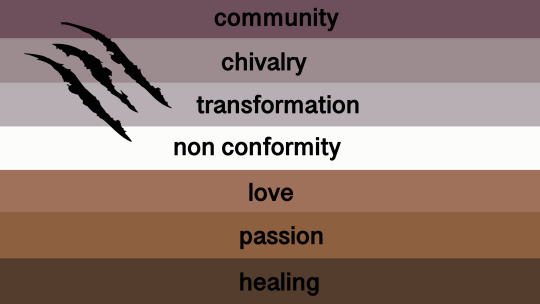
about werewolf
Introduction
“Werewolf” is a gender identity label that I started developing in 2023 and has grown with me since. It feels very personal and intrinsic to me, so I struggle to articulate it, but I will attempt to, borrowing language from feminist, LGBT, and queer/quare theory.In the past, I’ve described werewolf as “an amalgamation of transsexuality, butch-adjacent identity, otherness, therian-adjacent identity, and other things that are difficult to pin down” and that’s not wrong, but I’d like to try and communicate it with more specificity. Below, I will discuss my understandings of werewolf as 1) a practice 2) an experience 3) an identity and 4) a politic in seeking to provide a more complete picture. My explorations will likely sound extremely vague. That's the point! To describe werewolf too specifically is to limit it's potential and underestimate it's possibilities. Even though I “coined” werewolf as an identity, I believe it to be much bigger than me, and highly individualized due to the practice and experience components. All werewolves are unique, and bring their own meanings to the table. If you feel empowered by adopting it, I encourage you to define the concept yourself!
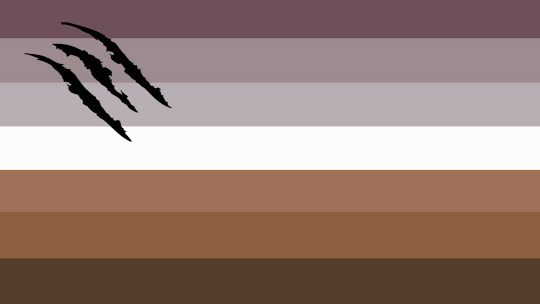
Prefer my original werewolf page? You can still see it here. I also have a more indepth flag breakdown there.

Notes
* On “werewolf” — I am not misspelling or ignorant of the fact that I use werewolf here in "grammatically incorrect” ways. This is intentional. I am using werewolf here as a community-identity term that acts as both a noun and adjective. I do this to assert my subjecthood and reject the heteronormalization of werewolves in many modern contexts.
I am not a werewolf, I am werewolf.
** On “quare” — I use quare here as a synonymous alternative to queer (used to mean strange or remarkable) to avoid confusion and to speak in conversation with E. Patrick Johnson’s proposed Quare Theory, which I encourage you to read up on if unfamiliar.
Werewolf as a practice
As a personal practice, werewolf is defined by actions and behaviors that do not align with understood heteropatriarchal, white supremacist, or capitalist norms. This can take a wide variety of forms depending on the individual werewolf’s experiences. The core tenet at the heart of the practice of werewolf is to outwardly express something internal that would normally be stifled by the dominant narratives and accepted norms.The practice of werewolf is differentiated from the experience in that practice is the physical, body moving activities, where the experience is the internal, emotional landscape. One may experience werewolf without practicing it, or vice versa.
For me, this manifests as a practice of unabashed sexual interest paired with chivalry, and a growing dedication to unlearn heterogender norms and imagine a healthy masculinity for myself.
Werewolf as an experience
As an experience, werewolf is defined by a tension within the self between the normative, acceptable elements (whether actual, imposed, or internalized) and the non-normative, quare elements of the werewolf’s life. The experience of chafing against the expected standard—and especially of desiring to break away from it—are fundamental.Werewolves also experience strife in communicating and existing in this space. Living as a werewolf is a form of labor, as failing to fit cleanly into normative society is hardship. This spans across different parts of a werewolf’s experience and relates closely to werewolf as a politic.
Werewolf as an identity
As an identity, werewolf relates closely to transgender, transsexual, and nonbinary identities. It is at its core a queer-aligned identity. Due to the transformative aspect to the identity, werewolf relates the feeling of some kind of change or inherent quareness of the body. It is an identity with multiple faces, many meanings, and many forms. Werewolf is also connected to therianthropy, otherkin, and animal identities. To identify as werewolf is to flag yourself as someone who relates to werewolves (in reality and in fiction) and adopt a dual-natured identity. It is auto-identified, so there are no criteria for who can and cannot identify as werewolf. The point of the identity label is to unify people who feel similarly, not construct a “normative” werewolf.For me, my werewolf identity is very closely connected to my butch identity, trans and queer identity, and my sexuality.
Werewolf as a politic
Werewolf operates as a political theory of the flesh—Cherrie Moraga describes theories of the flesh as “[the] physical realities of our lives—our skin color, the land or concrete we grew up on, our sexual longings—all [fusing] to create a politic born out of necessity”. To be politically werewolf is to understand the positionality of werewolves and desire to ameliorate the struggle that fundamentally defines werewolf existence through action. It is not a politic chosen or adopted, but one fundamental and essential to living in the hybrid space werewolf does. One cannot experience life as a werewolf without adopting a werewolf politic.further reading
Below, I will present a pseudo-bibliography with texts I find fundamental to my understanding of werewolf from both werewolf fiction literature, academic theory, and autobiography:werewolf fiction
Fiction that features werewolves explicitly (as a literal monster or identity):Rules for werewolves writ. Kirk Lynn, 2015
Lycanthropy and Other Chronic Illnesses writ. Kristen O'Neal, 2021
Ginger Snaps dir. John Jawcett, 2000
American Werewolf In London dir. John Landis, 1981
My Animal dir. Jacqueline Castel, 2023
Fiction that is werewolf in experience, politic, or pratice:
Bones and all dir. Luca Guadagnino, 2022
Love lies bleeding dir. Rose Glass, 2024
theory & autobiography
The Violence of Heteronormativity in Communication Studies:Notes on Injury, Healing, and Queer World-Making Yep, 2003
The Complexity of Identity:
“Who Am I?” Tatum, 2000
Understanding Partriarchyhooks, 2004
feminist scholarship: ethical issueshooks, 1989
Loving in the War Years Moraga, 1983
flag